Apple iPhone 16 review

Introduction:
The Apple iPhone 16 stands as the flagship of the series, bridging the gap between the standard and Pro models by offering a sleek design, faster hardware, enhanced connectivity, improved charging, and upgraded cameras.
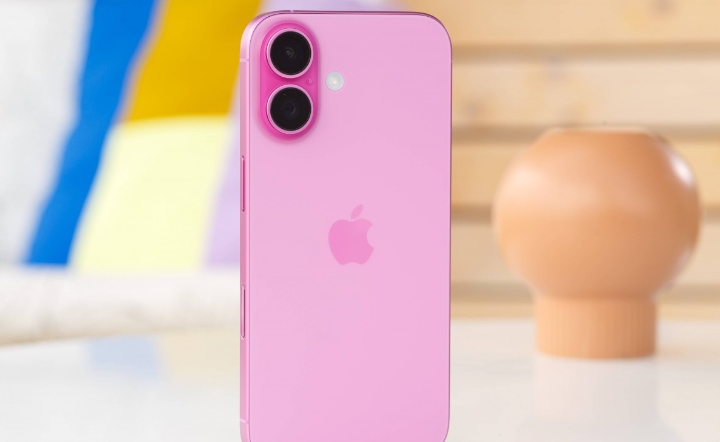
Apple iPhone 16 Review:
The iPhone 16 once again leads in durability with an upgraded Ceramic Shield glass, maintaining its IP68 rating for water resistance up to 6 meters. It features a familiar 6.1-inch Super Retina XDR OLED display, boasting high brightness, HDR10, and Dolby Vision support.
Powering the device is the new Apple A18 chip, providing a more powerful processor, superior graphics compared to the iPhone 15’s A16, enhanced memory bandwidth for AI tasks, and 8GB of RAM, similar to the Pro models.
Camera Updates:
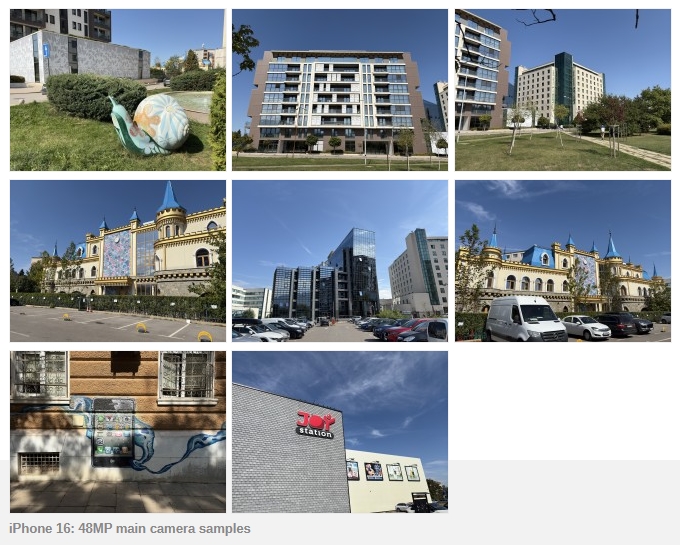
The rear dual-camera system has been upgraded, with a 48MP main camera featuring sensor-shift stabilization and Fusion technology, offering improved 2x in-sensor zoom. The ultrawide camera now has a brighter lens and autofocus, enabling better macro shots. The new Tone setting allows users to adjust camera tonal processing to suit their preferences.
Charging & Connectivity:
The iPhone 16 supports the next-gen MagSafe and Qi2 wireless charging, with up to 25W wireless charging when using the new MagSafe charger and a 30W+ power adapter.
The phone runs on iOS 18 and is fully compatible with the upcoming Apple Intelligence feature.

Key Specifications:
- Body: 147.6×71.6×7.8mm, 170g, Ceramic Shield front and glass back, aluminum frame, IP68 water/dust resistant.
- Display: 6.1″ Super Retina XDR OLED, HDR10, Dolby Vision, up to 2000 nits, 1179x2556px, 460ppi.
- Chipset: Apple A18 (3nm), Hexa-core, Apple GPU (5-core).
- Memory: 128GB/256GB/512GB storage, all with 8GB RAM.
- Camera: 48MP main, 12MP ultrawide; 12MP front camera with depth sensor.
- Battery: Fast charging, MagSafe wireless charging (25W), reverse wired charging.
- Connectivity: 5G, eSIM, dual SIM, Wi-Fi 7, Bluetooth 5.3, NFC.
Although Apple retained the 60Hz refresh rate, the powerful hardware makes the iPhone 16 an excellent gaming device capable of maintaining smooth 60fps performance. While the lack of a higher refresh rate is a downside, the iPhone 16 remains one of the most exciting compact phones this season.
Unboxing the iPhone 16:
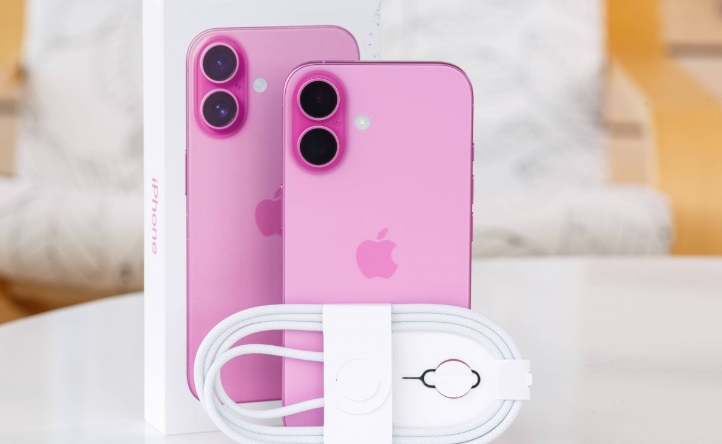
The retail package includes a braided USB-C cable and a SIM ejection tool. Notably, the paperwork is minimal, and the iconic Apple sticker has been removed.
Design, Build Quality, and Handling:
The iPhone 16, while being the most basic model in the series, still boasts one of the most premium build qualities on the market, a signature of Apple’s craftsmanship. Though there’s no major design overhaul, one significant change is the more refined and symmetrical camera housing, which blends more seamlessly with the overall design.

The phone features a dual-glass construction with a Ceramic Shield on the front, an aluminum frame, and a glass back made by Corning. Like the Pro models, the iPhone 16 also sports a matte finish on both the frame and back glass. However, it uses the second generation of Ceramic Shield, similar to the iPhone 15 Pro models, rather than the latest third-generation found on the iPhone 16 Pro.
Certified with an IP68 rating, the iPhone 16 exceeds the standard by being capable of surviving up to 6 meters of water for 30 minutes. Combined with its impact-resistant aluminum frame and Ceramic Shield, this makes the 170g device one of the most durable non-rugged smartphones available.
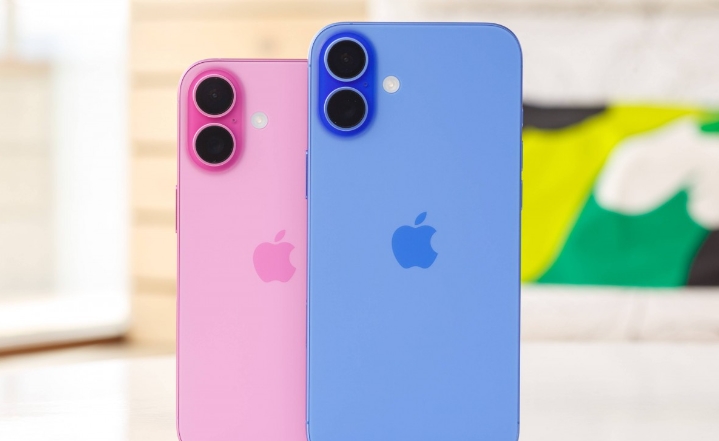
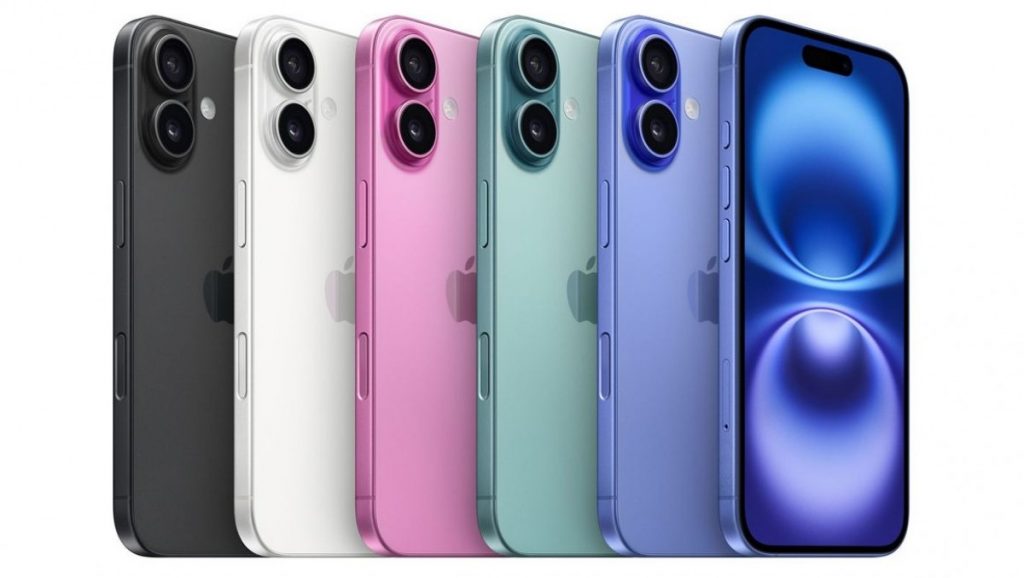
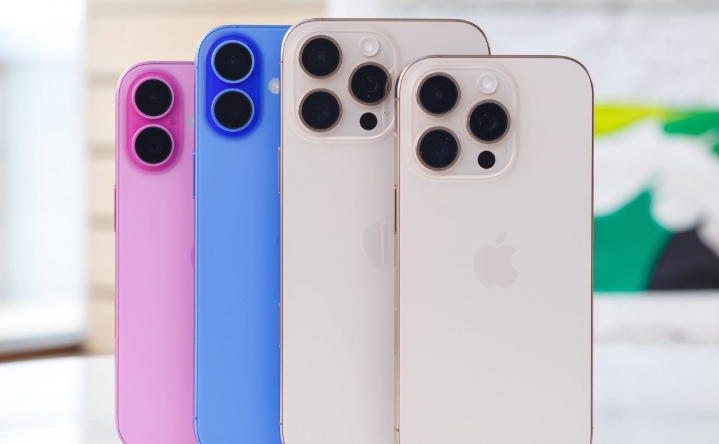
The iPhone 16 is offered in several colors, including Black, White, Pink, Teal, and Ultramarine.
Display:
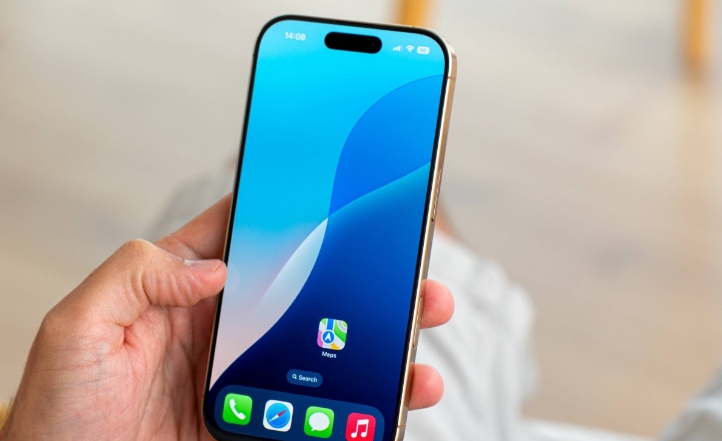
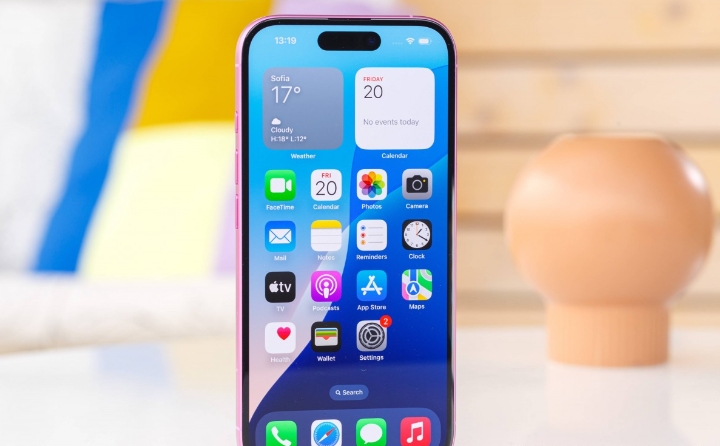
The front of the iPhone 16 is dominated by a 6.1-inch Super Retina XDR OLED display, which, although limited to a 60Hz refresh rate, impresses with its brightness, color accuracy, and top-tier HDR support. The bezels are minimal, though slightly thicker than those on the Pro models. The display also features the Dynamic Island, which houses the selfie camera, Face ID sensors, and other components.
Above the screen is a powerful stereo speaker that works in tandem with a bottom-mounted speaker, offering rich audio quality.
New Features:
The iPhone 16 introduces two new buttons. On the left side is the Action Button, while on the right side, below the Side key, is the innovative Camera Control button. This new button incorporates capacitive and force-touch layers, allowing for multiple functions. Apple is expected to add a two-step shutter feature soon, enhancing its utility for photography.
The Camera Control button takes interaction with the camera to new heights, offering more intuitive control. However, because it’s touch-sensitive, it can be accidentally activated, so setting it to respond to press rather than touch might be a better option.
Back Design:
The iPhone 16’s rear camera housing has been revamped with a smaller and more subtle pill-shaped design. Carved directly from the rear glass, this housing adds a premium feel and looks cleaner than previous models.
Dimensions and Handling:
The iPhone 16 measures 147.6 x 71.6 x 7.8mm and weighs 170g, identical to the iPhone 15. Its all-matte design helps resist smudges and offers decent grip, though it’s not completely slip-proof. Its compact size makes it easy to handle with one hand.
As with previous models, the iPhone 16 lacks a fingerprint reader, relying instead on the fast and reliable Face ID for security.
Overall Build:
Despite lacking the titanium found in some Pro models, the iPhone 16 maintains Apple’s high standards for build quality. It’s lightweight, easy to use, extremely sturdy, and waterproof, continuing Apple’s tradition of superb craftsmanship.
Display
The iPhone 16 features a 6.1-inch Super Retina XDR OLED screen, identical to the iPhone 15. It has a resolution of 2556 x 1179 pixels (460ppi), considered the new standard for Retina quality according to Apple, with a 60Hz refresh rate. The display supports HDR10 and Dolby Vision.
It includes a pill-shaped cutout, known as Dynamic Island, and is shielded by a second-generation Ceramic Shield.
Apple iPhone 16 review
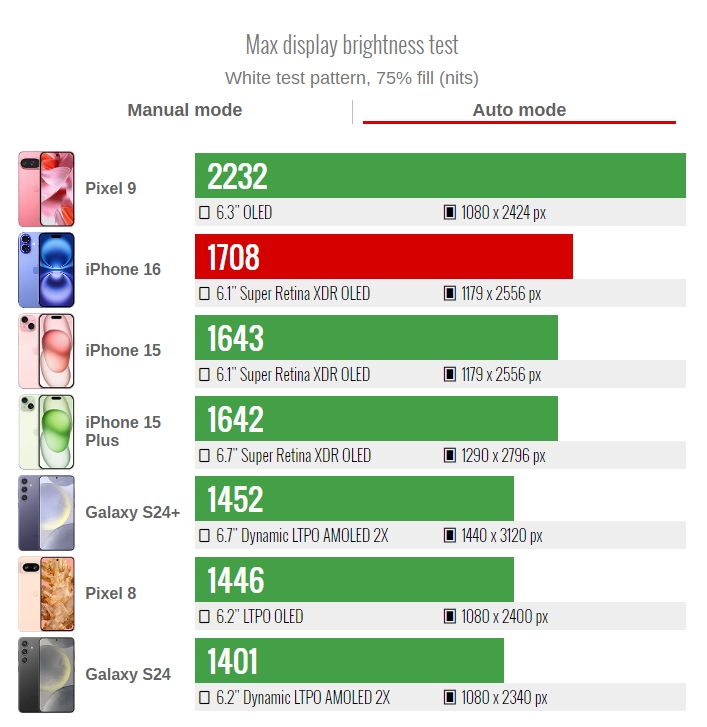
The screen also offers features like True Tone adjustments and can reach up to 1,000 nits of typical brightness and 2,000 nits at peak. Our testing confirmed that it delivers 857 nits of manual brightness and 1,708 nits in auto mode, close to the iPhone 15. Its minimum brightness is just 1 nit.
The iPhone 16 uses a 60Hz refresh rate and doesn’t have LTPO technology or an always-on display like the Pro models. It supports HDR10 and Dolby Vision in a flexible way that allows HDR playback even on portions of the display where video is playing.
Battery life
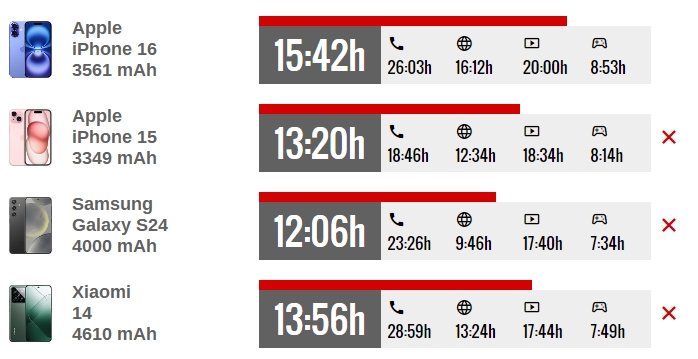
The iPhone 16 is powered by a 3,561 mAh battery, slightly larger than the iPhone 15. Despite the modest increase, its performance is commendable, offering a strong Active Use Score for a phone of its size.
Charging speed
The iPhone 16 supports fast wired charging, though Apple hasn’t revealed the maximum wattage. Apple claims it charges to 50% in 30 minutes with a 20W charger, but our tests show it maxes out around 30W. Wireless charging is supported up to 25W with MagSafe and up to 15W with compatible Qi2 chargers.
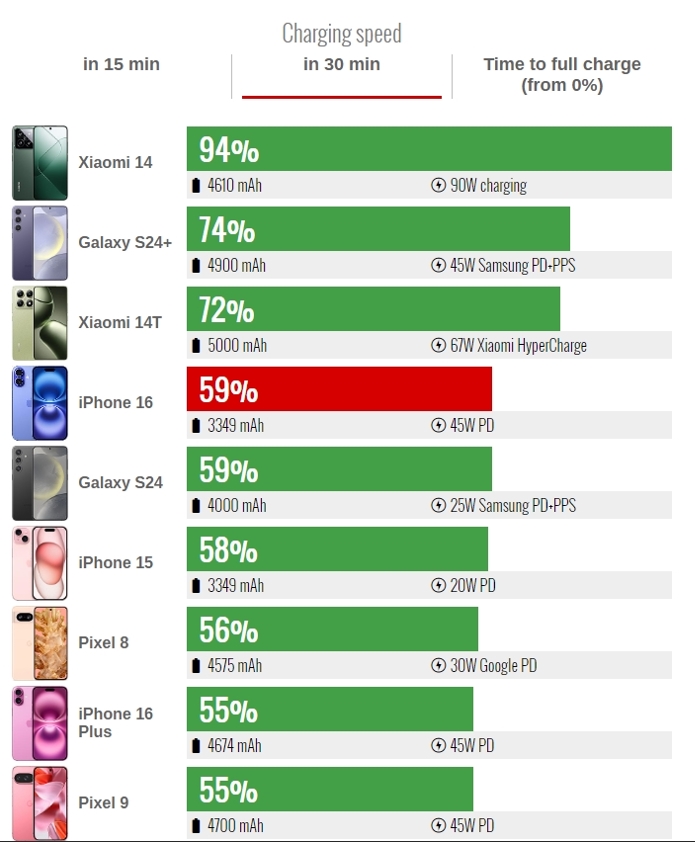
Using a 45W PD charger, the iPhone 16 reached 33% in 15 minutes and 59% in 30 minutes. Full charge took 1 hour and 42 minutes, with the last 15% taking 42 minutes.
Speakers
The iPhone 16 has stereo speakers, with the earpiece doubling as one. The sound quality is excellent, with deep and balanced audio. It performed very well in our loudness test, delivering clear and rich sound.
Apple iOS 18
The iPhone 16, 16 Plus, 16 Pro, and 16 Pro Max come with Apple’s latest iOS 18 pre-installed. While Apple marketed this update as one of the most significant redesigns, users may not notice a dramatic difference in everyday use. However, the introduction of extensive personalization options for homescreens and the interface allows for a more unique user experience, which has been somewhat lacking in previous iOS versions.
Apple continues its tradition of providing at least five years of iOS updates for all iPhones.
For a comprehensive overview of what’s new in iOS 18, check out our feature walkthrough.

Connectivity
The iPhone 16 offers various network connectivity options based on your region. In some areas, it includes satellite connectivity for emergency pings outside cellular range and satellite Roadside Assistance (subscription required). However, Emergency SOS and Find My via satellite have regional limitations.
It features tri-band Wi-Fi 7 and Bluetooth 5.3 with LE support, marking it as the first non-Pro iPhone to support the 6GHz Wi-Fi band. Additionally, it includes NFC for Apple Pay and Name Drop contact sharing.
The device is equipped with a second-generation Apple Ultrawideband (UWB) chip, enabling precise location tracking with directional arrows and tripling the range of the original U1 chip. This functionality may not be available in all markets due to regulatory issues.
The iPhone 16 and 16 Plus use a Type-C port backed by a USB 2.0 data connection, offering a theoretical maximum transfer speed of 480 Mbps, while faster connections are reserved for the Pro models. Video output is supported via DisplayPort DP (up to 4K) through Type-C Alt mode, allowing most standard Type-C hubs to mirror the display without any additional features like a desktop mode.
Performance, Benchmarks, Stress Tests
The major upgrade for the iPhone 16 and 16 Plus is the new Apple A18 chipset, which is two generations ahead of the A16 in the iPhone 15. This second-generation 3nm chip is designed to be both more powerful and energy-efficient.
The Apple A18 features a six-core processor with two performance cores running at 4.04GHz and four efficient cores at 2.2GHz. The GPU consists of five cores and includes improved hardware ray tracing capabilities. Both models come with 8GB of RAM, and our review unit has 128GB of fast NVMe storage.
In summary, the A18 CPU is approximately 30% faster than that of the iPhone 15 and 60% faster than the iPhone 12. The GPU boasts a 40% performance increase over the iPhone 15 and is twice as fast as the iPhone 12.
When comparing just the iPhone 16 to the iPhone 15, the 2024 model maintains the same CPU performance while consuming 30% less power, and it delivers equivalent GPU performance while using 35% less power. Additionally, memory bandwidth has been enhanced by 17% for AI applications.
Thermal management has also seen improvements, achieving 30% higher sustained performance in the iPhone 16 and 16 Plus due to a redesigned motherboard and a thermal substrate made from 100% recycled aluminum.
Many games that were incompatible with the iPhone 15 series can now be played on the mainstream iPhones, including titles like Resident Evil 7: Biohazard and Assassin’s Creed: Mirage. The upcoming Honor of Kings: World will feature an ultra graphics mode optimized for the iPhone 16. The GPU also supports hardware-accelerated ray tracing for games like War Thunder Mobile.
Benchmark Scores
We’ve included recent Android flagship scores for comparison, keeping in mind that cross-platform benchmarks should be viewed with caution.
The new Apple A18 CPU in the iPhone 16 scores about 20% higher than the A16 in the iPhone 15, with a 30% to 60% improvement in GPU performance depending on the 3D test.
GeekBench 6
- Multi-core:
- iPhone 16 Pro: 8283
- iPhone 16: 7901
- iPhone 15 Pro: 7172
- Xiaomi 14T Pro: 7081
- Galaxy S24: 6747
- iPhone 14 Pro: 6556
- iPhone 15: 6526
AnTuTu 10
- iPhone 15 Pro: 1566329
- iPhone 16: 1510034
- iPhone 15 Pro Max: 1487203
- iPhone 14 Pro: 1462912
- iPhone 15 Plus: 1385649
- iPhone 15: 1354651
- iPhone 14: 1299302
3DMark (Offscreen)
- iPhone 16 Pro: 4429
- iPhone 16: 3997
- iPhone 15 Pro: 3712
- iPhone 15: 3084
- iPhone 14: 2936
- iPhone 14 Pro: 2705
Benchmarks – GeekBench AI (NPU)
- iPhone 16 Pro: 44969
- iPhone 16: 44751
- iPhone 14 Pro: 22046
Apple has improved sustained performance significantly, with the iPhone 16 achieving 78% CPU and GPU stability, a notable increase from the 51% GPU stability of the iPhone 15.
Thermal Throttling
Overall, the iPhone 16 delivers flagship-level performance and stability, maintaining reasonable temperatures even during extended stress tests, making it an excellent choice for gaming.
iPhone 16 Camera Review
The iPhone 16 retains much of the camera technology from its predecessor, the iPhone 15, while introducing notable upgrades, particularly in the ultrawide lens. Here’s a comprehensive breakdown of its camera features and performance.

Camera Specifications
- Main Camera
- Resolution: 48MP
- Sensor Size: 1/1.56″
- Pixel Size: 1.0µm
- Aperture: f/1.6
- Lens Focal Length: 26mm
- Autofocus: Dual pixel PDAF
- Stabilization: Sensor-shift OIS
- Video: 4K@30fps
- Ultrawide Camera
- Resolution: 12MP
- Aperture: f/2.2
- Lens Focal Length: 13mm
- Field of View: 120 degrees
- Autofocus: Dual pixel PDAF
- Video: 4K@30fps
- Front Camera
- Resolution: 12MP
- Sensor Size: 1/3.6″
- Aperture: f/1.9
- Lens Focal Length: 23mm
- Autofocus: PDAF
- Video: 4K@30fps
Upgrades and New Features
- Camera Control Key:
- Features a tactile switch for capturing photos and recording videos.
- Allows customization of the press sensitivity (lighter to firmer).
- Supports third-party camera apps.
- Offers a “Clean Preview” mode for distraction-free shooting.
- Photographic Styles:
- Offers advanced filters that adjust tones and colors based on the subject.
- Users can create and save personal presets.
Daylight Photo Quality
- Main Camera: Captures stunning 12MP images with excellent detail, sharpness, and dynamic range. Colors are natural but may appear slightly muted. The 24MP and 48MP modes provide additional detail but are less accessible in the camera UI.
- Portrait Mode: Slightly decreases sharpness compared to standard photos but maintains good detail and background blur.
- 2x Zoom: Performs well with solid detail retention; however, quality slightly drops compared to 1x images.
- Ultrawide Camera: While detail and color reproduction are good, sharpness and dynamic range are lower than that of the main camera. The addition of autofocus enhances macro photography capabilities.
Low-Light Performance
- Main Camera: Exceptional low-light performance with clean, sharp images that retain detail without excessive noise. Night mode is automatically applied as needed.
- 2x Zoom: Consistent performance in low-light scenarios, comparable to daylight conditions.
- Ultrawide Camera: Provides decent results but can appear grainy. It falls short of expectations when compared to competitors in the same price range.

Selfie Camera
The 12MP front camera from the iPhone 15 excels in detail and exposure, even in challenging lighting. Autofocus enhances clarity, though indoor shots can suffer from slight sharpness loss.
Conclusion
The iPhone 16’s camera system strikes a balance between familiar strengths and innovative enhancements. The main camera performs excellently in various conditions, while the ultrawide and selfie cameras build on the previous generation’s foundation. With added features like the Camera Control key and Photographic Styles, it caters well to photography enthusiasts looking for versatility and quality.

The Competition
The base model of the iPhone 16, with 128GB of storage, is priced at USD 799/GBP 799/EUR 949/INR 79,900/CNY 5,999/JPY 124,800. If you opt for a storage upgrade, which is advisable since 128GB can be limiting, the 256GB version costs an additional $100/£100/€130, while the 512GB model carries a premium of $200/£200.
This is a significant investment for a new phone. However, the standard iPhone 16 remains the most affordable option in Apple’s current lineup, which could attract certain buyers. Another reason to consider this model is its size; with a 6.1-inch display, the iPhone 16 is one of the few compact flagship smartphones available today.
While we enjoy recommending Android alternatives to the iPhone, data shows that Apple’s smartphone lineup remains largely unique. Few users are transitioning to Android, and those who own iPhones are likely to continue purchasing them. Therefore, it makes sense to assess the iPhone 16 in relation to Apple’s other devices.
When exploring alternatives to the iPhone 16, we should first consider the most obvious options based on the previously mentioned reasons for buying. Although the iPhone 16 is the cheapest current model, “current” encompasses a broad definition in Apple’s context. The company is still selling the iPhone 15 and even the iPhone 14 on its website.
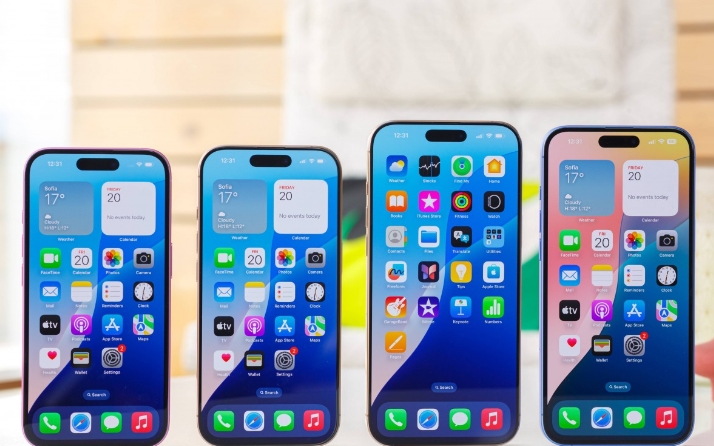
We hesitate to directly compare the iPhone 14 with the iPhone 16 as an alternative. However, the standard iPhone 15 is a strong choice. It lacks the new Camera Control button and certain performance enhancements, and you’ll miss out on the upgraded 8GB of RAM and the autofocusing ultrawide camera. If these compromises are acceptable to you, a base 128GB iPhone 15 can be purchased for around USD 830/GBP 575/EUR 690.
If budget isn’t a concern, the clear choice would be the iPhone 16 Pro. This model offers all the latest features from Apple in a compact design. However, it’s worth noting that the “small Pro” has grown slightly this year, providing a larger display and battery along with new technology, such as the updated 5x telephoto lens. Still, opting for the iPhone 15 Pro instead could save you some money without sacrificing much.
Our Verdict
It’s challenging to crown the iPhone 16 with any “innovation” accolades this year. While Apple typically avoids drastic changes, last year’s iPhone 15 introduced more notable upgrades, such as a new OLED display with Dynamic Island, the transition to USB Type-C, and a new 48MP main camera. These features have been carried over to the iPhone 16.
The iPhone 16 does introduce some new elements, including an autofocusing ultrawide camera, a Camera Control button, and a stronger emphasis on Apple Intelligence. However, many of these enhancements are still more about promises and future capabilities than immediate benefits, even though the hardware has been upgraded to support potential AI functionalities.
As in previous years, we find ourselves deliberating on whether to recommend the iPhone 16. Once again, Apple’s entry-level phone is solid overall, combining a mix of familiarity and slight innovation. While Android competitors may offer superior hardware and better overall value, this often feels secondary to the iPhone experience. Ultimately, if you’re using an older iPhone, the iPhone 16 is a perfectly suitable and satisfying upgrade option.
Pros
- Subtle redesign, especially appealing around the new camera area.
- Excellent build quality, water-resistant up to 6 meters, and industry-leading scratch and shatter resistance for front glass.
- Very bright OLED display, supporting HDR10 and Dolby Vision.
- Good battery life for its size.
- High-quality loudspeakers.
- Strong overall performance.
- Excellent photo and video quality across all three cameras, with appreciated autofocus on the ultrawide and the new Camera Control feature.
- Each iPhone receives at least five years of iOS updates.
Cons
- Significantly more expensive than comparable Android alternatives.
- The display is only 60Hz, lacks an Always On feature, and has thicker bezels compared to the Pro models.
- No charger included in the box, and charging speed is not particularly fast.
- Apple’s iOS restrictions may deter newcomers to the ecosystem.
- Lacks a dedicated telephoto camera.